

Article
The real reasons consumers buy protection plans (it's not what you think)
Why device protection plans are often seen as emotional purchases
It’s easy to assume that protection plans are emotional purchases. Ideas like peace of mind, fear of damage, or concern about loss often come to mind first as compelling reasons to buy. But the data reveals a shift in how consumers are making these purchase decisions.
In fact, economic considerations consistently outweigh emotional ones. 45% of consumers cite the cost of the product as a key decision driver, compared to 28% who prioritize peace of mind. Consumers tend to evaluate protection through a practical lens: what it costs, what it covers, and whether it feels worth it in the moment.
The challenge is that their cost equation doesn’t always evaluate the full picture. Decisions are often shaped by the most immediate and visible factors, which can leave important considerations out of the equation.
What consumers consider when buying device protection plans
When consumers consider protection, they’re making a straightforward comparison. They’re asking, “Is this plan worth what I’m paying right now?”
That evaluation is grounded in a few highly visible inputs.
- Up-front device price
- Monthly or one-time protection cost
From there, the decision often narrows quickly.
Factors that are less visible or harder to quantify tend to carry less weight, including:
- Likelihood of repair or failure
- Cost of replacement or service
- Downtime and disruption
- Impact on productivity, access, and daily life
The result is an imbalance in how decisions get made. Visible costs feel immediate and concrete, while hidden costs are easier to dismiss or overlook.
And these hidden factors aren’t theoretical. 41% of consumers report at least one smartphone-related issue each year, meaning disruption is common even if it’s not always catastrophic.
The real cost of device ownership: why devices are no longer optional
This incomplete view of cost becomes more important as the role of technology continues to expand. Devices have evolved from standalone products into essential infrastructure that powers daily life.
For most consumers, this shift is already well underway. 80% say connected technology makes life better, a 19-point increase in just a few years.
What was once a convenience is now a dependency.
Devices enable communication, work, banking, transportation, and identity. So when they fail, the impact extends far beyond the device itself.
And, importantly, failure doesn’t always look like breakage. Connectivity issues (35%) and storage limitations (30%) are more common than device damage (21%), meaning disruption is frequent, even if it’s less visible.
Downtime doesn’t just mean inconvenience. It means lost access, lost time, and, often, real economic impact.
Yet these costs are rarely part of the initial purchase decision.
What is “total cost of ownership” in device protection?
To bring those missing factors into view, it helps to shift from thinking about price to thinking about total cost.
The “total cost of ownership” metric reframes the purchase decision by incorporating the full economic picture.
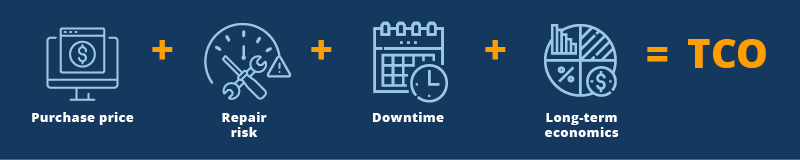
When purchase price, protection cost, repair risk, downtime impact, and length of ownership are considered together, protection takes on a different role. It becomes less about adding coverage and more about managing the overall cost of owning and using a device over time.
This is where protection delivers its strongest value: helping consumers account for the real, long-term cost of ownership, not just the up-front expense. TCO makes the full equation visible.
How to position device protection plans using TCO
Rather than introducing a completely new framework, the opportunity for brands is to build on how consumers already think.
The most effective protection plan strategies do two things.
Anchor protection plans in price, value, and practicality
Start with what consumers already consider.
- Price
- Practicality
- Expected lifespan of the device
These are already central to how decisions are made.
Make the full cost of ownership more visible
Then, expand the evaluation.
- What happens when a device fails?
- How long does resolution take?
- What does that disruption actually cost?
When these factors are made tangible, the value equation becomes clearer.
Protection starts to feel less like an added expense and more like a way to manage cost over time.
How to increase device protection plan value and attach rates
Framing plays a critical role in how protection is evaluated.
When positioned primarily as “peace of mind,” it can feel incomplete. When positioned as an added cost, it invites price comparison.
But when framed in terms of tangible outcomes, the conversation shifts to:
- Reducing total cost over time
- Minimizing disruption and downtime
- Extending the usable life of a device
This approach aligns with how consumers already think about value.
It also becomes more compelling when paired with flexibility. 85% of consumers say customizable protection plans make them more likely to purchase a device, and 87% say they increase retention.
As devices become more expensive and complex, relevance — not reassurance — is what drives decisions.
Why Total Cost of Ownership matters for carriers, OEMs, MSOs, and retailers
For carriers, OEMs, MSOs, and retailers, this creates a meaningful opportunity for growth. Because when protection aligns with real decision drivers, conversion improves, attach rates increase, and retention strengthens.
Framing protection plan relevance around TCO also reflects broader changes in the market.
As devices become more advanced, particularly with AI, the majority of consumers (61%) say AI-enabled smartphones make them more likely to consider protection.
At the same time, expectations for performance and support are rising.
Positioning protection within TCO helps connect these dynamics into a single, cohesive value story.
Device protection plans are an economic decision, not just peace of mind
Consumers don’t need to be convinced that protection matters. They need help seeing its full value. Today’s decisions are already grounded in economics, but they’re often based on partial information. TCO closes that gap.
It brings hidden costs into view, aligns protection with real-world usage, and shifts the conversation beyond up-front price toward long-term value.
In a connected world where devices are essential, the real opportunity isn’t changing how consumers think. It’s helping them see the full cost of what they already rely on.
Explore the full 2026 Global Connected Consumer Trends Report
Understanding how consumers evaluate protection is just one piece of a much bigger shift.
Across global markets, expectations are rising not just for technology, but also for the experience surrounding it. From personalization and AI to continuous support and ecosystem-wide service, the definition of value is evolving.
The 2026 Global Connected Consumer Trends Report breaks down:
- The six forces reshaping consumer expectations
- How technology sentiment varies across global markets
- Why support is becoming the ultimate differentiator
- What brands need to do to stay competitive

Assurant Editorial Team
The Assurant Editorial Team shares stories that inspire and empower, helping you unlock opportunities and stay ahead with the latest research and insights. Assurant is a premier global protection company that partners with the world's leading brands. As a Fortune 500 company operating in 21 countries, we leverage data-driven technology solutions to provide exceptional customer experiences.