
Article
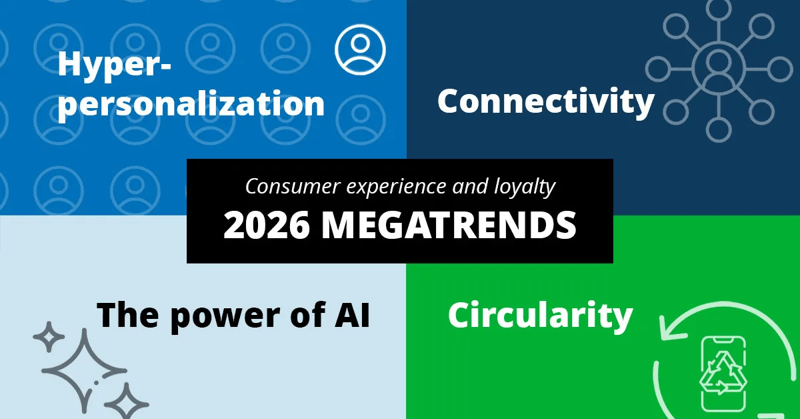
Four megatrends shaping customer experience and loyalty in 2026
A roundtable discussion with Assurant experts Maxime Larivé and Kevin Loong
This year's CES showed us that the consumer technology landscape is undergoing a fundamental shift. Consumers want more value from the brands they choose. For businesses in the mobile, MSO, retail, and connected device space, this presents both a challenge and an opportunity: How do you build lasting customer loyalty when the old playbook no longer applies?
To explore, we sat down with two Assurant leaders at the intersection of consumer behavior and business strategy. Maxime Larivé, Director of Strategy, and Kevin Loong, AVP of Business Strategy, shared their perspectives on the four megatrends that will define customer loyalty strategies in 2026 and beyond.
"What we're seeing isn't just a temporary shift," says Larivé. "Consumers have fundamentally changed how they evaluate technology. They want simplicity, value, and partners who understand their needs across the entire device lifecycle."
Megatrend 1: Connectivity is essential
Connectivity has become the invisible thread linking every aspect of modern life. From smartphones to smart thermostats, consumers expect seamless, always-on experiences that span devices, contexts, and environments. But subscription fatigue has reached a tipping point. Research shows 42% of U.S. streaming subscribers feel overwhelmed by the number of services they manage,1 and nearly half have canceled at least one subscription in the past six months due to rising costs.
"The opportunity here is bundling, but it has to be done right," explains Loong. "Consumers aren't looking for more options. They're looking for fewer decisions. We see engagement increase significantly for single connectivity support solutions that cover multiple needs with clear value."
Industry research supports this, showing that bundling increases product ownership by 1.5 to 2 times on average.1 For carriers, retailers, MSOs, and OEMs, this means designing for convergence rather than silos, aligning mobile, broadband, home, appliances, and the growing universe of connected devices into integrated experiences.
"More than 20% of consumers currently bundle mobile and broadband," Larivé states, "and interest is still growing. Likewise, 40% of TTM wireless adds come from MSOs, while MNOs are capturing broadband share with aggressive investment plans. What forward-thinking companies are recognizing is that, as connected environments expand to include more devices, they need to eliminate friction by prioritizing unified onboarding, management, and engagement across all use cases."
The shift is from selling moments to supporting lifecycles. Point-of-sale thinking is giving way to continuous engagement through setup, daily usage, troubleshooting, upgrades, and transitions between devices. The Assurant's Feature Exchange platform was designed with this trend in mind, making it easier for partners to launch, enable, and modify protection programs with more simplicity than traditional bundled offerings.
Megatrend 2: Hyper-personalization becomes table stakes
Personalization is no longer a competitive advantage; it's a baseline expectation. Industry data shows that hyper-personalized experiences can generate up to 40% more revenue compared to generic approaches.2 And yet, deep, trust-based loyalty dropped to 29% in 2025, a five-point decline from the previous year.3 Additional research shows 32% of customers will leave a brand after just one bad experience, regardless of previous loyalty.4
"Protection and support have historically been one-size-fits-all," observes Loong. "But consumers today demand more flexibility. Every interaction should feel relevant and intentional."
The key is data that better informs pricing, tailored bundles, proactive engagement, and faster resolution. But only if brands use that intelligence to reinforce trust rather than simply optimize conversion.
"There's also a shift in favor of subscription-based relationships," responds Larivé, "which means brands and retailers have more opportunities throughout the device lifecycle to cross-sell or support loyalty touch points. We're already at a point where 70% of customers expect personalization and tailored bundling as part of their service."5
This sentiment is at the heart of the Assurant "fit for you, not for all" approach featured at CES 2026. It's the idea that personalization isn't just a promise — it's a practice, and it can be seen in solutions like Protect Select, which allows partners to offer customizable protection options, the option to change coverages and benefits as needed, dynamic fulfillment capabilities that match customers with the right resolution path in the Assurant Repair Network, and hyper-personalized, modular solutions that evolve to meet business and consumer goals.
Megatrend 3: Circularity as a pillar of sustainability
As device prices continue to rise, consumers are holding onto their technology longer. According to Assurant's Q3 2025 Mobile Trade-In and Upgrade Industry Trends Report, the average age of devices returned through trade-in programs reached an all-time high of 3.8 years. At the same time, trade-in programs returned $1.59 billion in value to consumers during the quarter, a 46% increase compared to the same period last year.6 Additional data predicts the bring-your-own-device (BYOD) market will reach $276 billion by 2030, growing at nearly 16% annually. And one in four smartphones shipped globally is expected to be second-hand by 2029.7
"Circularity isn't just an environmental talking point anymore," says Larivé. "More than a third of consumers have bought previously owned phones, and nearly all would do so again. And nearly half of consumers are interested in trade-in and upgrade programs for nonmobile devices. Consumers across generations expect brands to deliver sustainable products and services. Manufacturers and retailers that participate in the circular economy are creating stickier relationships as a result."
For businesses, this means consolidating reverse logistics under one roof: integrating trade-in, repair, refurbishment, reuse, and responsible recycling to streamline operations and maximize both cost savings and environmental impact. It also means expanding circular programs beyond mobile devices into smart tech and appliances to unlock new revenue pools.
"The data layer is what ties it all together," adds Loong. "When you can connect intelligent platforms across the reverse logistics journey, you generate insights that drive smarter decisions. You see patterns in device returns, predict refurbishment demand, and optimize inventory in ways that weren't possible before."
Assurant's end-to-end device lifecycle ecosystem, including AI-powered diagnostics through Device IQ and sustainability tracking through Carbon IQ, helps partners meet consumers where they are in this evolving landscape. With only about 17% of e-waste8 currently recycled globally, companies that prioritize circular economy principles can differentiate themselves while contributing to sustainability goals that resonate with today's consumers.
Megatrend 4: Taking advantage of AI
AI has evolved from experimentation to necessary infrastructure. 65% of customer experience leaders now view AI as a strategic necessity, not a nice-to-have.9 Companies that fail to invest in AI-powered customer journeys are projected to see a 10% decline in customer satisfaction, while those that embrace it could see a 15% increase.10
But the challenge isn't just adopting AI. It's deploying it in ways that genuinely improve the customer experience, rather than adding complexity. Consumers are already interacting with AI in their daily lives through generative AI tools, chatbots, and intelligent assistants. This not only modifies expectations; it also generates new points of friction when brands fail to keep pace.
"Customers don't want to figure out where to go for help," explains Loong. “The shift we're seeing is from reactive support to proactive care. With connectivity and telemetry, we can detect issues before customers even notice them, anticipate needs based on usage patterns, and transform what used to be support interactions into ongoing care relationships."
"Applying AI across claims and support is where we see real impact," notes Larivé. "Intelligent automation improves speed, accuracy, and consistency, which translates directly to higher customer satisfaction and operational efficiency. The key is positioning AI as an enabler that enhances what consumers already know and love about a brand. That requires having your data, your services, and your customer experience infrastructure ready for a world where the customer might never visit your website directly."
Looking ahead: The loyalty imperative
These four trends share a common thread: consumer expectations are evolving, and business strategies need to evolve with them.
"The old model was transactional," reflects Larivé. "You sold a device, maybe attached a protection plan, and hoped the customer would return in two years. The new model is relational. You're a partner throughout the device lifecycle, from purchase through trade-in and upgrade. Every touch point is an opportunity to demonstrate value and deepen trust."
"What excites me is how these strategies reinforce each other," adds Loong. "Better experiences lead to stronger loyalty. Stronger loyalty leads to more trade-ins and upgrades. More lifecycle engagement means more data to personalize future experiences. It becomes a virtuous cycle."
The question isn't whether these trends will reshape the industry. It's whether your organization is prepared to meet consumers where they're headed.
References
1 https://www.simon-kucher.com/en/insights/state-streaming-services-us-navigating-subscription-fatigue-and-driving-retention
2 https://www.nice.com/info/top-ai-cx-trends-for-2025-how-artificial-intelligence-is-transforming-customer-experience
3 https://emarsys.com/learn/blog/customer-loyalty-statistics/
4 https://www.zopper.com/blog/3-reasons-why-device-protection-plans-drive-repeat-sales-and-trust
5 https://medium.com/@webelightsolutions/why-ai-powered-hyper-personalization-is-the-next-big-differentiator-in-customer-experiences-02b78e555d07
6 https://www.assurant.com/news-insights/infographics/q3-trade-in-upgrade-data-trends
7 https://www.mordorintelligence.com/industry-reports/byod-market
8 https://www.ey.com/en_us/insights/climate-change-sustainability-services/how-circular-economy-models-can-address-global-e-waste
9 https://www.zendesk.com/blog/ai-customer-experience/
10 https://www.mckinsey.com/capabilities/growth-marketing-and-sales/our-insights/next-best-experience-how-ai-can-power-every-customer-interaction

Assurant Editorial Team
The Assurant Editorial Team shares stories that inspire and empower, helping you unlock opportunities and stay ahead with the latest research and insights. Assurant is a premier global protection company that partners with the world's leading brands. As a Fortune 500 company operating in 21 countries, we leverage data-driven technology solutions to provide exceptional customer experiences.